I ran across an interesting blog post on the website of the American Enterprise Institute. It provided an introduction to an organization called Peers.org and their attempt to create a "sharing economy."
Here's the link to their video
https://www.youtube.com/watch?v=UzdSKHA-FvI
The idea would seem to be a good one. We have an attempt to show that our "self-interest" benefits by cooperation.
I would maintain that is similar to the modern market place. You and I meet the market place to cooperate through mutual exchange and we both benefit.
My question for the class is "Does the Peers.org approach lend itself to unethical behavior through free-riders; or does it merely simplify the marketplace with a return to barter based on some level of comparative advantage instead of using money as medium of exchange?"
I hope this generates some discussion.
I also remind you that you are responsible for initiating posts as well as commenting on posts by me or your fellow students as part of the course expectations.
Sunday, March 30, 2014

Tuesday, January 8, 2013
Self-Interest
Self-Interest
You may or may not be familiar with the on-line comic strip
XKCD. If you’re not, here’s an example that appeared in mid-December.
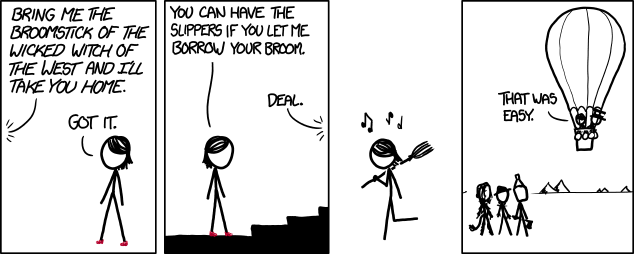

While the situation is based on a familiar piece of fiction,
it presents a good example of how ethics and economics meet. In the situation
depicted, the solution to the challenge presented by the Wizard is easy enough,
especially if one presumes self-interest as the only motive. However, one must
ask “how many of us would solve the problem that way?” (We can also use this to
discuss the ideas of barter and double coincidence of wants, but we don’t have
to explore that right now.)
Introductory Post
This blog is about economics and ethics. It is not unique in
this respect. There are others.
One might ask why produce a blog on this combination. For
many, they do not represent a natural fit. After all, isn’t economics about self-interest?
Isn’t that greed? How ethical can that be? But the fit is natural.
When we consider the roots of economics, the connection to
ethics is quite clear. Early economic ideas were often put forth by
philosophers such as Aristotle, St. Thomas Aquinas, and others. The founder of
modern economics is usually identified as Adam Smith. He was a professor of
moral philosophy. His Theory of Moral
Sentiments predates the Inquiry into
the Nature and Causes of the Wealth of Nations by sixteen years. And he intended
both of them to be part of a larger compendium – to be read together with ideas
that built on one another.
Over time, economics has developed into a separate field.
Its practitioners often state their work is positive rather than normative and
integrating ethics can lead away from that “scientific” ideal. Perhaps that is
true. But one thing is clear, our decisions and choices – the fundamental
building blocks of economics are tinted by our values and viewpoints – our
belief in what is right and wrong. We make choices based on values and
viewpoints we pick up from others, or that we fail to learn from others. So
this blog is one more attempt to better understand the questions we face, using
both economic and ethical insights to examine the choices we face and make. It
is an attempt to shed light on our “self-interest” and to consider what that
really means.
This blog is made possible by generous grant to Randolph-Macon College by BB&T for the study
of The Moral Foundations of Capitalism. We hope you find the posts interesting, entertaining
and thought-provoking.
Subscribe to:
Posts (Atom)